Showing posts with label Darren Aronofsky. Show all posts

Thursday, March 31, 2011

A Tempest in toe-shoes Pt III


Darren Aronofsky and Natalie Portman

Entertainment Weekly
EW.Com March 28, 2011

'Black Swan' director Darren Aronofsky defends Natalie Portman in body-double controversy
by Adam Markovitz

Responding to claims that Black Swan star Natalie Portman didn’t do the majority of her on-screen dancing in her Oscar-winning role, director Darren Aronofsky released the following statement through studio Fox Searchlight:

“Here is the reality. I had my editor count shots. There are 139 dance shots in the film. 111 are Natalie Portman untouched. 28 are her dance double Sarah Lane. If you do the math that’s 80% Natalie Portman. What about duration? The shots that feature the double are wide shots and rarely play for longer than one second. There are two complicated longer dance sequences that we used face replacement. Even so, if we were judging by time over 90% would be Natalie Portman.

And to be clear Natalie did dance on pointe in pointe shoes. If you look at the final shot of the opening prologue, which lasts 85 seconds, and was danced completely by Natalie, she exits the scene on pointe. That is completely her without any digital magic. I am responding to this to put this to rest and to defend my actor. Natalie sweated long and hard to deliver a great physical and emotional performance. And I don’t want anyone to think that’s not her they are watching. It is.”

Last Friday, ballerina Sarah Lane told EW that Portman only danced 5 percent of the full-body shots in the film. She also claimed that one of the film’s producers asked her not to speak publicly about her work during Oscar season. Lane’s comments came after Black Swan choreographer (and Portman fiancé) Benjamin Millepied told the L.A. Times that Natalie did “85 percent” of the dancing in the film. Lane could not be immediately reached for comment regarding Aronofsky’s statement.

Personal comment: I think with the film editor’s counts “139 dance shots in the film. 111 are Natalie Portman untouched. 28 are her dance double Sarah Lane.” that is probably the end of the discussion. Although I don’t think it necessarily addressed Sarah Lane’s contention that “Of the full body shots, I would say 5 percent are Natalie” since there were a great many upper body and leg/feet shots that NP may have done and we don’t know what the editor included or excluded in his count of ‘dance shots’. Even so, I’m so sorry that Sarah Lane seems (to me) to be coming off in this whole thing as whiney.

Entertainment Weekly
EW.Com March 28, 2011

Mila Kunis blasts 'Black Swan' controversy: 'Natalie danced her a- - off.'
EXCLUSIVE by Adam Markovitz


Black Swan co-star Mila Kunis is speaking out in support of her friend and cast mate Natalie Portman amid accusations that the bulk of the dancing in Portman’s Oscar-winning role was actually performed by her dancing double, American Ballet Theatre soloist Sarah Lane. “Natalie danced her a– off,” says Kunis. “I think it’s unfortunate that this is coming out and taking attention away from [the praise] Natalie deserved and got.”

Kunis also says Portman has been honest about how much of the demanding footwork she was — and wasn’t — able to do. “She’ll tell you [that], no, she was not on pointe when she did a fouettés [turn]. No one’s going to deny that. But she did do every ounce of every one of her dances,” she says. “[Lane] wasn’t used for everything. It was more like a safety net. If Nat wasn’t able to do something, you’d have a safety net. The same thing that I had — I had a double as a safety net. We all did. No one ever denied it.”

Last week, Lane told EW that she performed 95 percent of Portman’s full-body dance shots. Portman has been defended vocally by fiancé and Black Swan choreographer Benjamin Millepied and director Darren Aronofsky, who insists Portman did 80 percent of the dancing in the film.

Personal comment: I guess Mila needed to get her name into the publicity. I don’t think the comment “Natalie danced her a– off” contributed much to the discussion, but her comments did show solidarity with the official, and apparently correct position, based on the film editor’s dance shot count.

More on Ballet sex by Jack: “I understand that one's posture and muscle tension in the legs, pelvis and back change when one is wearing pointe shoes. There is a quite similar change when one is wearing very tall heels with the difference perhaps that in the latter the weight can be carried on the heel and so the leg muscles are involved differently. But I would think that if the heel height is extreme the pelvic and back involvement is quite similar. And then there is standing on ones "tippy-toes", admittedly difficult for any length of time, but a similar muscular change would take place. Obviously ballet dancers stretch and strengthen their leg muscles so that this "unusual" posture is normalized so that they can stand, dance, and move about on their toes. I am not convinced that having "sex" in any of those three - pointes, extreme heels, or tippy-toes is very different. I'd think for a male it's hardly distinguishable. Of course someone who has developed more muscle control, her legs and pelvis can provide a different experience to her partner and herself presumably, but that would be true whether she was en pointe, in killer heels, or on her tip toes and so sex with a well developed female body is better than one that's not. We get it. I'm not getting it Jill, but perhaps I need to experience a side by side test so to speak. Ha-ha-ha That would be fun! Tester is blindfold for a double blind (ha-ha-ha) study.”

My reply: You recall that ballet sex was an outgrowth of the Paris Opera ballet dancers taking their lovers en pointe to offer a similar, tightened, grip to lovers that patrons experienced when frequenting prostitutes wearing high heels in Paris brothels. These days Strippers stilettos, ballet boots and pointe shoes all readily available for purchase. So a woman has a choice as to what level of skill she is willing to train for, to acquire a tightened grip to please a lover. To a true connoisseur of the female leg and the velvet vice of a ballerina’s vagina high heels then and now with the wearer’s toes flexed are not comparable to pointe shoes, because the flexed toes break the line of the leg and suggest that the woman in heels hasn’t the skill, muscles and stamina necessary to take a lover with her strongest grip while balanced on the platforms of pointe shoes. Even a woman in 5 inch stripper’s heels – which hold the wearer on three-quarter pointe - can’t compete and is relegated to third place behind ballet boot sex.

As to whether differences in the tightness and strength of the grip en pointe is distinguishable from when she is standing flat or is on her back it almost always is, but it depends on the woman, how long she has been taking pointe and how much time she spends on her toes. There are other considerations as well such as sexual experience and OB history, but the length of time she clenches her vaginal muscles, when she rises and remains en pointe, is a major indicator of how tight she will be. In some cases, me for example, I have to consciously concentrate on relaxing my muscles so a lover can comfortably enter me. But of course I wear Ban Wa balls or a Penetrator as much as I can, sleeping with the balls inserted when I’m not with a man or if he has taken me with them inserted, so I’m always training and exercising my muscles.

Saturday, March 5, 2011

Toni Bentley reviews Black Swan

Natalie Portman in “Black Swan.”

“The movie provides the most recent -- though most egregious -- example of the “ballerinas-are-victims” stance that certain good Samaritans love to embrace,” writes Toni Bentley,

Why I posted this review:
I admire Toni Bentley immensely for her knowledge of ballet and her ability to translate that knowledge into words on paper which make her books fascinating reading. So it is with sadness, but understanding, that I read her unfavorable review of the film Black Swan.

Dancers are very self-critical always seeing flaws in their own performances and trying to improve and that hyper-criticality will sometimes spill over to their non-dance lives. I have some dancer friends who are unable to relax and enjoy a dance performance from the audience. They are continually watching for missteps, errors of commission or omission by the performers, to the extent that they can’t enjoy the performance. I think for many dancers who didn’t like Black Swan, that is what has happened. In critiques you read: Portman isn’t a ballerina… No one who only trained for a year can adequately portray a body that has been trained for 15 years… There is not enough dance… Most dance scenes were shot from the waist up… Ballet isn’t all rabid ballet moms, bloody toes, eating disorders and predatory Artistic Directors. But no one denies that these things exist in ballet and many dancers and devoted ballet fans dislike having that pointed out in a popular film. And many hate the idea of using the duality of Odette / Odile in Swan Lake as the frame story on which to hang a dramatic psycho-thriller of a dancer going insane. Toni Bentley wanted an entirely different film and she didn’t get it. Even so, I think this review is worth reading. I am indebted to J for bringing this review to my attention.

THE DAILY BEAST

Butchery at the Ballet

by Toni Bentley
February 25, 2011 8:48pm

“Oscar and audiences may love Black Swan, but one former New York City Ballet dancer thinks it’s nothing more than “balletploitation.” Author Toni Bentley explains why Darren Aronofsky’s psychological thriller is insultingly off pointe.

I have tried to avoid writing about Darren Aronofsky’s pirouetting parody Black Swan, but, having been a professional ballet dancer for George Balanchine, I keep getting asked what I think of the movie. And now that it has garnered a huge audience, numerous passionate fans and five Oscar nominations, it is time to put on my toe shoes, wrap my ribbons, paint on my four-inch black eyebrows, lace-up my wet-tutu suit and take a grand jeté into Aronofsky’s swamp. I mean lake.

I first saw this film at a screening last November, before it opened to the public. I had high hopes: Aronofsky had done a great deal of homework on the “ballet world,” consulting with many dancers, myself included. Reading the script a year or so previously, I’d been baffled by its reductive simplicity. But, hey, I thought, what do I know about script writing—and Aronofsky and his people seemed like earnest folk.

The film opens with a gorgeous low-lit scene of a ballerina’s beautiful legs and feet ensconced in the shimmering satin sheaths that are the art’s greatest symbol, dancing to the great soaring strains of Tchaikovsky’s passionate score. Oh goody, I thought, I will be swept away by this: the magic, the music, the beauty, the lines, those hypnotizing arched feet that skim the stage on their toes like purring paws (the ballerina was, of course, not the film’s star, Natalie Portman, but her double, Sarah Lane, a real dancer from American Ballet Theatre.)

Unfortunately it proved a terrible tease—the only lyrical moment in a film ostensibly about a lyrical art prior to the onslaught of histrionics that ensue.

One hundred and eight minutes later, as the movie ended, the friend I took—not a dancer—turned to me and asked in all seriousness, “Was that supposed to be camp?” There, on the screen, was a beautiful, bleeding-into-her-tutu Portman as the White Swan, uttering those portentous dying words: “Perfect . . . It was perfect.” As a dancer, I have never been so perfectly insulted.

I had thought when I read those words in the script, this is really stupid simple (the opposite of wicked smart, I would venture), but maybe Aronofsky has one of those things you hear film directors sometimes have: a vision. This was the vision? A dead ballerina in a bloody tutu with the caption “It was perfect”? He could not possibly be basing a film on a ballet dancer—the most fleet, complex, and powerful artist of the physical that exists—and the great 19th-century love story that is Tchaikovsky’s Swan Lake by reducing it to one crazy girl’s addiction to perfection. Or could he? Is this how he sees our art? Like a profession full of self-destructive addicts that need an A&E Intervention, a Dr. Phil “How’s it working for you?” talk, or an Oprah bailout? Aronofsky totally missed—or dismissed—the love story that is the raison d’être of the entire ballet and, instead, myopically latched on like a pit bull (and with the same finesse) to the White Swan/Madonna-Black Swan/whore dichotomy and then delivers his sophomoric dissertation with a sledgehammer. He does, however, clearly delineate his Cygnini discoveries: a White Swan masturbates in white grannie panties, while a Black Swan goes (black) thongless into the night. (Aronofsky clearly has a penchant for mutants: his next film is The Wolverine.)

Black Swan provides the most recent—though most egregious—example of the “ballerinas-are-victims” stance that certain good Samaritans love to embrace (“those dancers are too thin, they are just too too thin”) on occasion to aggrandize themselves, while patronizing those superb creatures whose absolute commitment to excellence they cannot understand. Ballet is the practice of physicalized morality, a poetic standard for every man and woman's ideal capacity," wrote Lincoln Kirstein, who founded the New York City Ballet with Balanchine. To imply that its proponents, dancers, are victims rather than teachers provides swift avoidance of that uncomfortable suggestion. Aronofsky has created a movie celebrating the failure of a ballerina, and by implication her entire art—disguised, insidiously, as a film about sacrifice and success.

As Black Swan so clearly demonstrates, one simply cannot “act” being a ballerina. It is a state of being, of feeling, of mind, an externalized expression of internalized discipline, faith, and good manners.

But I am too harsh. Perhaps Black Swan is simply Aronofsky’s bloody, melodramatic, nonsensical, middle-of-the-road, badly-written bid for box-office success after he tasted its heady brine with the success of the excellent The Wrestler. It could have been such rip-roaring good fun (see Jim Carrey's rendition from Saturday Night Live). And a real nice break from the dull, repetitive, hard work of a true ballerina. But then Black Swan isn’t a film about real ballerinas at all, no more than Jurassic Park is a film about real scientists (or real dinosaurs for that matter)—it merely exploits the locale, the props, and the outerwear. Balletploitation is born.

This brings us to Aronofsky’s heroine: his waify, whiny, bulimic little ballerina, Nina Sayers. Don’t you just love her? The little swan who simply couldn’t fly. And then we hear—over and over —that poor hard-working Natalie Portman had to actually lose weight and work really, really, hard—I mean really hard—for a number of months to pass, barely, as a professional dancer in the film, and only then between her neck and waist (don’t look further down: it isn’t there. Even her double—the one who actually did work really hard for several decades—is hardly on screen). A ballerina without her legs and feet is like a writer without words or a singer without a voice: not one. No wonder Portman looks so beleaguered in the film: she is perhaps the first amputee professional ballerina. But, hey, it’s Hollywood, and she has already won a Golden Globe and will likely garner an Oscar for her dorsal efforts. (Her upper-body-only performance does, however, enable her to wear the first strapless tutus in dance history.)

“The world of ballet,” Portman told French Vogue after making the film “is sick, sick, sick.” Portman, however, has bravely overcome her distaste and is marrying, and reproducing, into the profession all the same. Portman is a lovely actress of considerable accomplishment in other films, but here her one-note earnest angst, denoted by furrowed brow from start to finish, is entirely unlike any real ballerina—a woman who “must have the nobility of a five-star general,” as Agnes de Mille once said—rather than Portman’s insecure little misery. As Black Swan so clearly demonstrates, one simply cannot “act” being a ballerina. It is a state of being, of feeling, of mind, an externalized expression of internalized discipline, faith, and good manners. And of course, one needs those inconvenient legs and feet.

While the result is one almost hilariously sensationalistic movie (Aronofsky even misses being either high or low camp), I have a sneaking suspicion that the director wanted his film, at least in part, to be about the Birth of an Artist. He wants to bludgeon his tutu and wear it too. In straddling his themes—a serious film about the making of an artist, and Psycho at the ballet—he misses both, and flaps around in no swan’s lake.

This, of course, the public is lapping up, especially, I surmise, the vast audience caught in the fangs of vampire love (the Twilight books and movies, True Blood, The Vampire Diaries.) Black Swan has all the same seductive red, white and black elements of blood, innocence, and death delivered with risible solemnity and repressed sexuality. Nosferatu gets a tutu! Besides, there is nothing quite like white feathers and tulle to slowly absorb and spread the blood of a nice deep, suicide stigmata. And what did Nina stab herself with? Oh yes, a shard of her smashed dressing room mirror. I get it, I get it, the mirror murder, death of narcissism by narcissism (the buzzword for those obsessive ballerinas.)

I don’t care in the least that Aronofsky’s depiction of the ballet world and its anxious protagonists uses every blatant cliché about this rarified world, where anorexia, bulimia, self-mutilation, suppressed sexuality (but lots of attempted masturbation!), jealousy, stage mothers from hell, and vulgar, violent, lascivious company directors predominate. And don’t forget the requisite bloody toe close-up. Ewww! (For the record: A bloody toe for a ballerina is like a bruise for a boxer: ho-hum.)

Aronofsky displays neither respect, nor wonder, nor fascination, nor, alas, love for ballet in his film—he sees only half-clad wacko women: all four women in his mutilating misogynistic fetish are uber-crazy chicks. Predictably, he also repeats the truly absurd notion that a young female dancer needs drugs, alcohol, a wild tattooed girlfriend, and pick-up sex to the din of deafening disco music to “loosen up,” to be sexy and alluring on stage. This is a shameless manipulation (hello Hollywood!) to give regular teenage girls a point of connection to those rarified creatures. But the fact remains that reckless, self-destructive girls are simply not the ones who succeed in ballet—they are dropouts who must go to college. Aronofsky did, however, almost win me over with the prospect of skinny crazed lesbian ballerinas in sex scenes with themselves and each other (how else to get men to a movie about ballet?) But even here, the scenes are both passionless and humorless.

Despite all this—or, more likely, because of it—Nina Sayers is the first crazy ballerina to have reached across the elitist wall of the ballet convent into the general public’s awareness, since 1986 when our own bona fide great ballerina Gelsey Kirkland wrote her bestselling memoir Dancing On My Grave (could have been Aronofsky’s title). Kirkland’s real-life drama did include starvation, vomiting, drug addiction, rivals, failed plastic surgery, multiple obsessions, and bad sex with Baryshnikov. (Kirkland was diagnosed by the world-renowned analyst Dr. Otto Kernberg as having borderline personality disorder while under his inpatient care.) Suffice it to say that no real ballerina, Kirkland included, would survive, much less succeed, with such an illness. It is important to note that Kirkland was a very great ballerina before she unraveled—not, sadly, after.

What is even sadder is that the only glimpses of the ballet world that most of the general public sees—and then believes—are these extreme aberrations. I have heard it said of Black Swan’s popularity: “But at least ballet is going on people’s radar.” Better ballet stay off their radar, if so inaccurately represented as a world of insane perfectionists, rather than what it is: a world of masterful devotees to beauty.”

Toni Bentley danced with the New York City Ballet for 10 years and is the author of five books including “Winter Season, A Dancer’s Journal” and “The Surrender, An Erotic Memoir.” She is a Guggenheim Fellow, and her story “The Bad Lion” was recently published in “Best American Essays 2010."

Tuesday, December 14, 2010

Pointe; on the making of Black Swan

The "Swan Lake" corps, including Natalie Portman as Nina

Pointe Magazine
By Jennifer Stahl
Published in the December 2010/January 2011 issue.

The Price of Perfection

Sarah Lane is standing onstage holding a syringe of fake blood. “When do you want me to start dripping it?” she yells out to the house. It’s the last day of filming the dance scenes in Black Swan, and I’m sitting next to director Darren Aronofsky inside SUNY Purchase’s Performing Arts Center. The atmosphere on set reminds me of a tech rehearsal as dancers stand around waiting while crew members fiddle with the lights. But the combination of familiar dancer faces, high-profile Hollywood big shots and the bizarre scene they’re filming seems almost surreal.

A crew member comes over to suggest that they digitally sub the blood in later, using the same technique the director did with the staples in Mickey Rourke’s skin in The Wrestler. Aronofsky says no. He wants to try it with the real (fake) blood. I cringe, imagining how each 30-second take is going to ruin a perfectly good pair of $80 pointe shoes.

The word “rolling” echoes three times through the theater and Act III Swan Lake music screeches out of the speakers. The corps, dressed in white swan tutus with gray scratch marks around their eyes and blackened finger tips, runs in Petipa’s familiar patterns. Lane rises to bourrée and starts squeezing the syringe. A camera rolling at ankle level trails after her pointe shoes, which are quickly drenched in red. It’s clear that this is not going to be your typical dance film.

With any new movie about ballet, dancers both anticipate and dread Hollywood’s take on their world. Black Swan, the latest addition to the genre, hits theaters December 1. But while Aronofsky includes a few of the expected clichés—bulimic purging, a pushy stage mom, the requisite pointe shoe breaking-in and bloody-foot shots—the movie is a much darker depiction of dancers than what usually makes it to the screen. Black Swan is less an intimate portrait of life in the studio and more a horror film about obsession gone awry, the moment when dedication becomes destruction. Even the color pink takes on a menacing tinge.

The story focuses on a performance of Swan Lake and mirrors the ballet’s plot—but takes it in a nightmarish direction. Nina (Natalie Portman), an eager, naïve soloist at a fictional New York City ballet company, has just been cast as Odette/Odile, and is determined to be “perfect” in her first principal role. Yet she has been so sheltered by her life in ballet that embodying the black swan’s sensuality becomes an agonizing struggle. The company’s artistic director (Vincent Cassell) urges Nina to let go, to lose control, to be more like Lily (Mila Kunis), a new company member who effortlessly oozes sex appeal—and who also looks eerily like Nina and seems to be angling for her part. As Nina follows the director’s advice, she becomes possessed by her desire to pull off an impeccable performance. The line between reality and hallucination grows murkier for both her character and the audience in increasingly bizarre, even gruesome scenes. A sinister version of Tchaikovsky’s score plays through nearly every scene, creating an intensely dramatic backdrop.

The corps is supplied by Pennsylvania Ballet dancers on post-Nutcracker layoff, plus a handful of freelancers. Portman and Kunis were given ballet back up by American Ballet Theatre’s Sarah Lane and Maria Riccetto, respectively. The two perform as body doubles in studio and stage scenes, dancing Swan Lake choreography that has a slightly contemporary update courtesy of New York City Ballet’s Benjamin Millepied. “Ben wanted to keep the classical choreography,” says Aronofsky, “but I told him to make it funkier. Now it even has traces of the funky chicken.”

With such high-powered ballet talent, it’s disappointing how little dancing made it into the final product. And a few balletic missteps are distracting: There’s oddly only one cast with no understudy, and the lead is never called “Odette/Odile,” but “Swan Queen.” However, behind the heavy-handed horror, Aronofsky captures the mentality of a perfectionistic, self-destructive dancer with disturbing accuracy. By cutting the film loose from the confines of realism, he shows from the inside out the psychological toll that ballet takes on dancers.

Still, building an R-rated thriller out of the world of ballet seems like an odd choice. Aronofsky, though, says it was simply a natural consequence of taking everything—from the characters to the colors of the sets and costumes—from the original ballet. “If you look at Swan Lake, it’s actually very gothic, dark and tragic,” he says. “When you turn the fairy tale into a real-world story, that tone carries over.”

Aronofsky began working on the project about 10 years ago when he came across a script titled The Understudy, set in the world of off-Broadway theater. He had always been fascinated by ballet (his sister studied it seriously growing up), so he hired a writer to revamp the screenplay using Petipa’s ballet as a jumping-off point. “Ballet was something that I never understood or grasped, but was a world unto itself,” says Aronofsky. “And, like wrestling, it’s a world most people haven’t seen from the inside.”

He made a couple of movies in the interim, but Black Swan stuck in his mind. So after wrapping The Wrestler, he decided to dust off the script and examine performers on the opposite end of the high-low art spectrum. “We spent a year researching to fully understand the psychology of a ballerina, the nuances and character traits,” says producer Scott Franklin. Dancers such as former NYCB principal Heather Watts and ABT’s Gillian Murphy and Julie Kent provided the filmmakers with insight and backstage access. “I started to realize this profession is incredibly difficult and very painful, even,” Aronofsky says. “I thought, ‘Oh my gosh, how do I capture that?’ ”

Key to his vision was casting an extremely capable screen actress who could dig deep into the mind of a disturbed dancer. He hired Portman, who did her homework as well, immersing herself in the world of ballet to fully understand her character. “I was definitely inspired by the type of dancer who’s a ‘bunhead,’ very much infantilized by her work,” says Portman, whose ingenious performance is already receiving Oscar buzz. “There’s the high-pitched voice, the desire to please, the total surrender to a male director.”

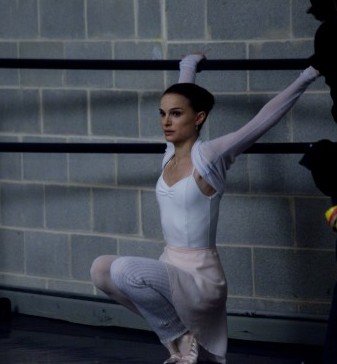
To conquer the balletic demands of the role, she took daily private classes for 10 months before filming, and got additional swan-specific coaching from the late ABT ballet mistress Georgina Parkinson. “Getting the arms right was especially important for me because much of the film is shot very close up,” Portman says. Lane stands in for the character’s major dancing in wide shots (sometimes using digital face replacement technology) as well as in close-ups on the hands and feet. But Portman does the majority of her own dancing, mostly in the takes that focus on her upper body. Although she is sometimes stiff and awkward, her swan arms are surprisingly convincing.

While Portman spent days in the studio working on choreography, the professional dancers were given only a handful of hours to learn their steps. They rehearsed briefly before filming to make any needed adjustments, such as tweaking traffic patterns to accommodate the cameraman. “The most challenging part was to repeat every single movement thousands of times,” says Riccetto. Sarah Hay, who plays one of the corps dancers in the film, adds that they had to keep pushing themselves for each take, since they never knew which was going to be used. Most saw this as an opportunity they don’t get with live performance. “We would work for hours on one tiny set of movements, just perfecting and perfecting them,” Lane remembers. From talking to the dancers about the filming process, it’s apparent just how astutely Aronofsky captured their perfectionism.

In a way, the authenticity with which Black Swan highlights this particular dimension of ballet draws attention to what Aronofsky left out: the thrill of moving, the joy of creating art with your body, the high of a great performance. Black Swan is a brilliant snapshot of ballet’s dark side. But, although we all know the vicious black swan is the sexier role, it’s too bad moviegoers will miss out on seeing the beauty of the white.

Jennifer Stahl is Pointe’s senior editor.

Personal comment: Another take on the film. Black Swan is not yet playing here, Sigh! It’s nice to see that ABT dancers Sarah Lane and Maria Riccetto are mentioned as body doubles for the foot, leg and long shot scenes where technique matters. The link to the above article is HERE.

Sunday, December 5, 2010

Black Swan - Opening weekend


Natalie Portman as Nina Sayers/the Swan Queen

The Los Angeles Times
Company Town
The Business behind the Show
December 5, 2010

'Black Swan' has bravura debut in limited release

"Black Swan" has danced away with what may be the best opening weekend of the year for a movie in a limited number of theaters.

Director Darren Aronofsky's psycho-sexual drama about the world of competitive ballet starring Natalie Portman and Mila Kunis took in nearly $1.4 million from 18 theaters in eight cities, according to an estimate from distributor Fox Searchlight.

Its per-theater average of $77,459 is the second highest for any film this year, behind only last weekend's "The King's Speech." But that British drama opened at only four locations, making the debut of "Black Swan" arguably more impressive.

Its strong performance, despite negative reviews from a few prominent publications including the Los Angeles Times, demonstrates that audiences in big cities such as Los Angeles, New York and Chicago have a strong interest in the picture. Searchlight hopes that will continue as the movie expands nationwide over the next several weeks.

"The King's Speech" also continued to play very well, taking in $325,874 at six theaters on its second weekend.

Strong performances for both movies indicate that audiences are excited for the bounty of low-budget films aiming for awards voters' attention coming out at the end of the year.

Ben Fritz

Personal comment: What great news! Now if the film just has legs!

Friday, December 3, 2010

Black Swan - the NYT review

Natalie Portman as Nina Sayers/the Swan Queen

The New York Times
December 2, 2010
Movie Review 'Black Swan'

On Point, on Top, in Pain
By MANOHLA DARGIS

A witchy brew of madness and cunning, “Black Swan” tells the story of a ballerina who aches, with battered feet and an increasingly crowded head, to break out of the corps. Played by Natalie Portman in a smashing, bruising, wholly committed performance, the young dancer, Nina, looks more like a child than a woman, her flesh as undernourished as her mind. When she goes to bed at night, a nearby jewelry box tinkling “Swan Lake,”a crowd of stuffed animals watches over her, longtime companions that — as Nina and this dementedly entertaining film grow more unhinged — begin to look more like jailers than friends.

Crammed with twins — lookalikes, mirrored images, doppelgängers — the story follows that of the “Swan Lake” ballet in broad, gradually warped strokes. It opens with the artistic director of a fictional New York ballet company, Thomas (Vincent Cassel), announcing that the new season will begin with a “visceral and real” version of that old favorite. To that end he dumps his prima ballerina, Beth (Winona Ryder), and picks Nina to dance the dual role of the swan queen (an enchanted woman in bird form) and her villainous black twin. But as the pressure builds, things fall apart, or Nina does. She stumbles out of a spin and begins scratching at her skin. One day she strips a piece from her finger as lightly as if she were peeling a banana.

Part tortured-artist drama, “Black Swan” looks like a tony art-house entertainment. (Hey, there’s Lincoln Center!) But what gives it a jolt is its giddy, sometimes sleazy exploitation-cinema savvy. The director Darren Aronofsky is a well-schooled cinéaste, and in “Black Swan” he riffs on Michael Powell and Emeric Pressburger’s ballet masterpiece, “The Red Shoes,” and the pair’s “Black Narcissus,” among other influences. But it’s also likely that Mr. Aronofsky, who was born in 1969 and grew up in Brooklyn, frequented Times Square when it was known as the deuce and lined with movie palaces playing the best and worst in trash cinema. I bet he also caught a few episodes of the “Red Shoe Diaries” on cable.

That isn’t a knock. One of the pleasures of “Black Swan” is its lack of reverence toward the rarefied world of ballet, which to outsiders can look as lively as a crypt. Mr. Aronofsky makes this world (or his version of it) exciting partly by pulling back the velvet curtains and showing you the sacrifices and crushingly hard work that goes into creating beautiful dances. Nina doesn’t just pirouette prettily, she also cracks her damaged toes (the sound design picking up every crackle and crunch) and sticks her fingers down her throat to vomit up her food. Mostly, though, she trains hard, hammering her toe shoes into floor much as Jake La Motta pounded his fists into flesh. She’s a contender, but also a martyr to her art.

Mr. Aronofsky is happy to see her bleed. A filmmaker who likes to play around with genre while mixing the highbrow with the lowdown and dirty, he has built a small, vivid catalog by exploring human extremes with wildly uneven degrees of visual wow, sensitivity and intelligence. He trawled the lower depths in “Requiem for a Dream” and struggled to scale the metaphysical heights with “The Fountain,” a fable about eternal (as in, when will it end?) love. For his previous movie, “The Wrestler,” he proved his commercial smarts by taking Mickey Rourke out of deep freeze and dusting off a comeback story that was old when Wallace Beery wiped Jackie Cooper’s runny nose with the script for “The Champ.”

“Black Swan,” by contrast, surprises despite its lusty or rather sluttish predilection for clichés, which include the requisitely demanding impresario (Mr. Cassel makes a model cock of the walk) and Nina’s ballerina rival, Lily (Mila Kunis, as a succulent, borderline rancid peach). But, oh, what Mr. Aronofsky does with those clichés, which he embraces, exploits and, by a squeak, finally transcends.

Such is his faith in his ability to surmount the obvious (and the lethally blunt) that he turns Nina’s mother, Erica (a terrific Barbara Hershey), into a smother-mother who out-crazies Faye Dunaway’s Joan Crawford in the mommy dearest department. You don’t know whether to laugh or shriek (both are reasonable responses), and it is this uncertainty and at times delicious unease that proves to be Mr. Aronofsky’s sweet spot.

It’s easy to read “Black Swan” as a gloss on the artistic pursuit of the ideal. But take another look, and you see that Mr. Aronofsky is simultaneously telling that story straight, playing with the suffering-artist stereotype and having his nasty way with Nina, burdening her with trippy psychodrama and letting her run wild in a sexcapade that will soon be in heavy rotation on the Web. The screenplay, by Mark Heyman, Andrés Heinz and John McLaughlin, invites pop-psychological interpretations about women who self-mutilate while striving for their perfect selves, a description that seems to fit Nina. But such a reading only flattens a film that from scene to scene is deadly serious, downright goofy and by turns shocking, funny and touching.

With “Black Swan” Mr. Aronofsky has found a surprisingly accommodating vehicle for his preoccupations, including bodies in pain, and his ever more refined technique. Here, working with his usual cinematographer, Matthew Libatique, and largely shooting hand-held in both super-16-millimeter film and digital, Mr. Aronofsky opts for grit over gloss, an ideal strategy for a story with a harsh underbelly. Hand-held cinematography can be lazy shorthand for “reality” (as if life happens in shaky-cam), but here the hand-held visuals work because of their intimacy. The influence of the Belgian filmmakers Jean-Pierre and Luc Dardenne can be seen in the close, tag-along shots of Nina’s head as she hurries off, a point of view that brings you within breathing, at times panting, distance of a character whose behavior can be off-putting.

Though it had its moments, “The Wrestler” felt like the work of a director who, after proving his street bona fides and bombing at the box office, decided to try some pandering. It worked: Mr. Rourke was rediscovered, and Mr. Aronofsky’s future was salvaged, in part because he had closed the distance between the fallen star played by Mr. Rourke and the one he himself had become. Ms. Portman’s performance in “Black Swan” is more art than autobiography, and as a consequence more honest, but because it’s so demandingly physical the lines that usually divide actresses from their characters are also blurred. This is, after all, Ms. Portman’s own thin body on display, her jutting chest bones as sharply defined as a picket fence.

Although Mr. Aronofsky focuses on her head, shoulders and arms, mostly avoiding long shots that might betray a lack of technique, Ms. Portman does most of her own dancing (and plausibly, at least to this ballet naïf). The vision of Ms. Portman’s own body straining with so much tremulous, tremendous effort, her pale arms fluttering in desperation, grounds the story in the real, as do the totemic Lincoln Center buildings, the clattering subway and the grubby, claustrophobic apartment Nina shares with her mother. Together they create the solid foundation of truth that makes the slow-creeping hallucinatory flights of fantasy all the more jolting and powerful. Much like the new version of “Swan Lake” that Thomas creates, “Black Swan” is visceral and real even while it’s one delirious, phantasmagoric freakout.

“Black Swan” is rated R (Under 17 requires accompanying parent or adult guardian). Bedroom gymnastics and graphic violence.

BLACK SWAN

Opens on Friday in New York and Los Angeles.

Directed by Darren Aronofsky; written by Mark Heyman, Andrés Heinz and John McLaughlin, based on a story by Mr. Heinz; director of photography, Matthew Libatique; edited by Andrew Weisblum; music by Clint Mansell; ballet choreography by Benjamin Millepied; production design by Thérèse DePrez; costumes by Amy Westcott, ballet costumes by Kate and Laura Mulleavy of Rodarte; produced by Mike Medavoy, Arnold W. Messer, Brian Oliver and Scott Franklin; released by Fox Searchlight Pictures. Running time: 1 hour 50 minutes.

WITH: Natalie Portman (Nina Sayers/the Swan Queen), Vincent Cassel (Thomas Leroy/the Gentleman), Mila Kunis (Lily/the Black Swan), Barbara Hershey (Erica Sayers/the Queen) and Winona Ryder (Beth Macintyre/the Dying Swan).

Personal Comment: I’m so pleased that the NYT critic liked the film! Not that a critical success necessarily translates into a box office success. It has to be liked by the ticket buying public but that a film and dance critic for the Times thought it was great really helps. Sarah Lane, a Soloist for American Ballet theater, is the body double for Natalie during dance scenes where ballet technique mattered.

Sarah Lane ABT Soloist and Portman’s body double

Monday, November 1, 2010

Black Swan an appreciation


Natalie Portman costumed as Odile in the film Black Swan

The New York Times
HOLIDAY MOVIES
October 30, 2010
By TERRENCE RAFFERTY

A Dark Transformation to Strains of ‘Swan Lake’

“WHEN I started thinking about ‘Swan Lake,’ ” said Darren Aronofsky, whose new film, “Black Swan,” is about a young dancer wrestling with the demanding lead role in that ballet, “a dancer, I think Julie Kent, said to me that the story is really about a girl who gets caught by an evil magician who turns her into a swan during the day and a half-swan, half-human at night. It popped into my head, ‘Oh, a were-swan.’ And I realized I was making a werewolf movie.”

It seems not to have occurred to him, even at that moment of enlightenment, that good werewolf movies are nearly as rare as good ballet films, but the thought probably wouldn’t have daunted him much. “I mean, that was probably one of the major things that attracted me to the story,” he said, “the idea of putting Natalie Portman through this physical transformation. That’s what the fairy tale is about.”

Physical transformation is, after all, what ballet is about too: the stretching and shaping and molding of a body into a form that makes impossible movements possible, and allows a creature of flesh and blood to transcend the limitations of the merely human and take flight (at least metaphorically) into the region of the sublime. Well, that’s the idea anyway.

The reality, as Ms. Portman discovered in training for her role in “Black Swan” (opening Dec. 3), can be as harrowing as a horror movie. “I’d studied ballet,” she said recently by phone, “from the age of 4 to about 13, at the American Dance Theater Workshop on Long Island, which is associated with the Eglevsky Ballet, and from the time I became an actress I think I always wanted to do a ballet film.”

Mr. Aronofsky, whose sister had also been a serious ballet student in her youth, approached Ms. Portman with the idea for the film while she was still in college, but when, years later, the time finally came to make the movie, she said, “I quickly realized that I wasn’t as advanced as I thought I was.”

Before shooting began, she trained for months with the former New York City Ballet dancer Mary Helen Bowers. She also “really immersed myself in ballet for a whole year,” she said, reading autobiographies of dancers (especially from the New York City Ballet) and discovering in them “almost a religious quality, not only in the deification of Balanchine, but also in all this sort of ritualistic, devotional behavior dancers practice — the repetitive barre work every day, breaking in the toe shoes and sewing the ribbons on and so forth.”

Nina, the young dancer Ms. Portman plays, lives a virtually monastic life, sharing a cramped Manhattan apartment with her overbearing mother (played by Barbara Hershey) and venturing forth only for company classes and rehearsals. And this, as Ms. Portman told it, was her existence too during the making of “Black Swan.”

“Basically,” she said, “I didn’t do anything except work. There was no, like, meeting up with friends for dinner or going to the movies. We’d do 16-hour days, then I’d go home and work out, because I had to stay in shape, and I’d prepare for the next day’s scenes and then get maybe five hours of sleep. It was really, really extreme.”

Her character, struggling to master the good swan, bad swan dynamic of the ballet’s central role and enduring the emotional manipulations of the company’s Balanchine-like artistic director (played by Vincent Cassel), gradually goes mad — which, in the strange, hermetic little horror-movie world of “Black Swan,” isn’t necessarily a detriment to her performance.

“I’m always very interested in performance,” said Mr. Aronofsky, 41, “and this story is about that, which gives it, I think, a clear connection to ‘The Wrestler,’ ” his 2008 film with Mickey Rourke. “When I finished at the American Film Institute, in my early 20s, I made a list of movies I wanted to make someday, and ‘The Wrestler’ was at the top, and a ballet film may have been the second.”

What attracted him to ballet as a movie subject is “an intensity in it that is so over the top, so overwrought, so melodramatic,” he said. “And the stories of ballets like ‘Swan Lake’ are often based on fairy tales, and they can be really Gothic and really tragic.”

He’s onto something there. Because ballet is a profoundly inefficient narrative medium, the stories have to be fairly simple and stark, as they are in fairy tales. And of course transformation into something that is not quite human (like the “were-swan” here) or even fully inhuman (like the automaton in “Coppelia”) is both inherently scary and, in this peculiar art, weirdly thrilling. The ability to play a seductive mechanical doll or a big beautiful bird is a measure of a ballerina’s virtuosity.

Poor ambitious Nina’s insanity is, in a way, just an occupational hazard: ballet dancers train for years, changing their bodies utterly, so they can get up on a stage and make us believe that they are someone, or something, they’re not. A certain over-the-top-ness is built right in. So Nina’s dancing gets better as she becomes crazier, growing more and more estranged from herself.

“I’d always been interested in doing something with Dostoyevsky’s ‘Double,’ ” Mr. Aronofsky said, “and when I saw ‘Swan Lake’ for the first time, I was blown away that it was one dancer dancing both roles.”

At a certain point the story of “Swan Lake” grafted itself onto a script called “The Understudy,” by Andres Heinz, which was, Mr. Aronofsky said, “set in the Off Broadway theater world and was kind of a combination of ‘The Double’ and ‘All About Eve,’ with a little bit of Polanski’s ‘Repulsion’ in there too.”

After a couple of more writers — first John McLaughlin, then Mark Heyman — and 20 or 30 drafts, Mr. Aronofsky was satisfied that he had a movie he could make, and one that, despite its relatively un-commercial subject matter, audiences might want to see.

“I thought,” he said, “that there hadn’t been many interesting movies about ballet, except for Michael Powell’s ‘Red Shoes.’ Ballet is such a unique world, very sexy and very specific, and I think one of the main reasons people go to the movies is to be taken to places they haven’t seen before.”

As it turned out, getting “Black Swan” onto the screen proved to be much tougher than he’d anticipated, “a super-difficult film to make,” he said, in part because that “very specific” world of ballet proved, at first, to be surprisingly unwelcoming.

“Usually when you say you want to make a film about a particular world, doors open up, you get tremendous access,” Mr. Aronofsky said. “But the ballet world wasn’t like that at all. It’s very insular. And dancers never want to do anything that might in any way interrupt their schedule.”

But he eventually engaged the New York City Ballet principal Benjamin Millepied to choreograph “Swan Lake” for the screen, and Mr. Aronofsky was, he said, pleasantly surprised by how much Ms. Portman was able to do. There are, he said, some 300 visual effects in the picture, but he’d expected to have to use many more.

“Natalie was able to give me a lot of stuff that I was unbelievably excited and impressed by,” he said. “Ninety percent of what you see is Natalie, un-retouched.”

There are remarkably few horror movies about the terror and violence of making art, but “Black Swan” is in that tiny company. (So is “The Red Shoes.”) Ballet, as it happens, is an ideal vehicle for a story about the blood, sweat and madness of creation, and it’s kind of appropriate that was itself something of an ordeal.

“It was a very serious set,” Ms. Portman said, “not a funny, silly set at all.” She paused a few seconds, then added, quietly: “It was scary, disciplined and rigorous, and I think, in a way, that fit into the mindset of the characters.”

Even now she sounded a little awed. Mr. Aronofsky’s film is about a feeling all performers are familiar with, the spooky sense, when you’re in full flight, that you’ve crossed over into the dark territory of dream, or fairy tale, somewhere you haven’t seen before. It’s the exhilaration of losing yourself, and the fear of being lost to yourself forever.

Personal Comment: I think this is the most realistic and positive article I’ve seen about Black Swan set in the compulsive world of ballet with its continual training and quest for perfection of line and technique with the human body. With Portman saying of NYCB dancers:

“almost a religious quality, not only in the deification of Balanchine, but also in all this sort of ritualistic, devotional behavior dancers practice — the repetitive barre work every day, breaking in the toe shoes and sewing the ribbons on and so forth.”

Absolutely! And there’s nothing wrong with that!

“Nina’s insanity is, in a way, just an occupational hazard: ballet dancers train for years, changing their bodies utterly, so they can get up on a stage and make us believe that they are someone, or something, they’re not. A certain over-the-top-ness is built right in.”

I wouldn’t have phrased it quite that way, but he’s right.

“Usually when you say you want to make a film about a particular world, doors open up, you get tremendous access,” Mr. Aronofsky said. “But the ballet world wasn’t like that at all. It’s very insular. And dancers never want to do anything that might in any way interrupt their schedule.”

Schedule conflict is a convenient excuse, but with the exception of cameo roles for established stars ballerina roles in dance films are quite often the kiss of death for a woman wanting a serious career with a national ballet company. There is a feeling that the dancer is taking time from perfecting her art to make a commercial film something a seriously committed dancer wouldn’t do.

“…Ballet is such a unique world, very sexy and very specific, and I think one of the main reasons people go to the movies is to be taken to places they haven’t seen before.”

It will attract a niche market of dance enthusiast and, occult followers but it will need the curious in the general public to be successful. I hope it is a huge success!

Sunday, July 25, 2010

Female ballet dancers and stress


Natalie Portman, the new face of Parfums Christian Dior.

Ballet dancers and psychoses: You don’t hear much about it but the more talented a dancer the more likely she is to have mental issues. I think it’s because we are pulled in so many directions simultaneously and because we have the determination to succeed. I don’t think men are nearly as affected by the mental strain. That’s because women are not only judged on artistic ability (musicality, classical technique and dramatic presentation), but on physical beauty and body image as well. In addition we are pulled by societal norms between career and marriage and children by our non-dancer family and friends. We are talking about women who are comfortable playing dress-up portraying doomed temple dancers, enchanted swans and ghosts of betrayed virgins for a living while being expected to function flawlessly in a 21st centaury world. Sometimes that gets complicated.

Being a classical ballet dancer is a career (not a lifestyle) that many young women aspire too but few actually succeed in attaining, because the physical, societal and mental demands of the profession are so at odds with 21st century social norms. The 1948 film The Red Shoes portrayed some of the stresses that pull on female dancers. Today the film The Red Shoes is considered over-the-top by some because it stresses an either-or situation; dedication to the dance vs. marriage and family. Over the years not a whole lot has changed for most female dancers. It’s true that Stars of major companies can take a year off to have a baby but if you are a young aspiring dancer with talent having a family is something carefully avoided for fear of being overtaken and passed by your competition.

Sorted by scents: Forty years ago George Balanchine (of blessed memory) sorted his favorite women in the NYCB by scents, giving his favorites different perfumes so he could tell by the fragrances who was in the building. All his wives were dancers, women who were his muses: Vera Zorina (December 1938–1946), Maria Tallchief (1946–1952), and Tanaquil LeClerq (1952–1969), as was his girlfriend, Alexandra Danilova (1926–1933). Toward the end of his life a muse who resisted his charms and managed to get away (to the determent of her career) was Suzanne Farrell.

Farrell joined NYCB in 1960 and was promoted to Principal in 1965. In 1969 she married Paul Mejia, another dancer in the company, over Balanchine’s objections and the couple left the New York City Ballet in 1970. After a period of self-exile in Europe, where Farrell danced for Maurice Béjart’s Ballet of the 20th Century, she returned to Balanchine and the New York City Ballet in 1975, where her partnership with Balanchine lasted until his death in April 1983; his last works were solos for Farrell.

Christ and the Magdalene: The Balanchine-Farrell relationship is the stuff of legend, a real-world fantasy that played out for all to see on the NYCB stage at Lincoln Center. In 1965 Balanchine choreographed his version of Don Quixote for Farrell. In the first performance Balanchine danced the role of the Don while Farrell danced Dulcinea. The ballet was not a critical success. However, it is remembered as a striking example of the real-world lust of a man for a woman presented as ballet. For me the most telling scene in the ballet is where Dulcinea washes the Don’s feet and dries them with her hair, a scene reminiscent of Mary Magdalene drying the feet of Christ with her hair, a relationship not much different than the one between Balanchine and the then 19 y/o Farrell.

Now, more than forty years later, even though Feminism has advanced women’s rights much further than in the sixties, the role of women in ballet while better has not changed all that much. That’s because the competition, mental focus and physical requirements necessary for young women just starting their careers are so intense that few can mix dedication to a career and life outside the ballet world. I don’t think Nina will be another Victoria Page, but it will be fascinating to see what Darren Aronofsky, Natalie Portman and Mila Kunis will do with Black Swan, a 21st century Hollywood film about a severely stressed ballet dancer.

Saturday, July 24, 2010

Black Swan ballet thriller

Natalie Portman as Nina in Black Swan

USA TODAY
By Susan Wloszczyna

First look: Ballet thriller 'Black Swan' from Darren Aronofsky

The Venice International Film Festival apparently can't get enough of Darren Aronofsky, even if he has switched his focus from muscle-bound men to dainty dancers.

The director took home a Golden Lion, the event's top prize, for The Wrestler in 2008. Now he has been given the honor of opening this year's 11-day event on Sept. 1 with Black Swan, a ballet-themed thriller due in late fall. "The cast and crew of Black Swan are both excited and humbled by the selection committee's invitation," Aronofsky said in a press announcement. "It is an honor to walk the great red carpet on the Lido, and we are excited to premiere our film to the wonderful audiences in Venice."

The dark tale with psychological twists stars Natalie Portman as Nina, a technically brilliant ballerina whose life takes some strange turns after being picked as the lead in a New York City production of Swan Lake. Pressures mount as her overbearing mother (Barbara Hershey) pushes her to succeed and her manipulative dance master (Vincent Cassel) commands her to be more seductive and loose in her performance.

Complicating matters is the arrival of Lily (Mila Kunis), a sultry dancer who exhibits all the innate ease and sexuality that Nina lacks. Nina begins to fixate on the newcomer as the two forge an unusual relationship. "The worldwide attention given to the Venice film festival provides an exciting launch for Black Swan," says Nancy Utley, president of Fox Searchlight. "We are very proud of our collaboration with Darren."

After its premiere in Venice, The Wrestler went on to awards season glory, earning actor Mickey Rourke his first Oscar nomination and a chance at a career comeback. Fox Searchlight, which bought The Wrestler at the Toronto film festival after its Venice success, has similar hopes for Black Swan— and especially for Portman, who was nominated for an Oscar for her supporting part in 2004's Closer.

As the actress tells USA TODAY about her troubled Nina: "The character was very interesting to play, always challenging and surprising. The fact that I had spent so much time with the idea — Darren and I started discussing doing the film in 2000 — allowed it to marinate a little before we shot."


USA TODAY
By Susan Wloszczyna

'Black Swan' stars step deftly into roles

PURCHASE, N.Y. — Four ballerinas bedecked with white feathers crisscross their arms in front of their bodies and hold hands as they await their music cue, a refrain from Tchaikovsky's Swan Lake. They repeat to exhaustion the rapid-fire footwork and angular poses that are intentionally more funky than refined.

Soon, they will be freed from the rigors of moviemaking. This is the final week for filming dance scenes in the psychological thriller Black Swan, opening later this year.

Something even funkier is going on in the wings, however, as tulle-draped actress Mila Kunis flirts with a costumed Benjamin Millepied, the popular member of the New York City Ballet who is making his movie debut as an actor and a choreographer. Much to his surprise, she follows director's orders and suddenly grabs his crotch, causing the crew to
explode in laughter.

After a break, Natalie Portman re-enacts a similar scene opposite Millepied, her real-life beau, but minus the brazen groping. Meanwhile, Vincent Cassel as the dance master takes his place before the camera and proclaims, "Your mission is destruction through seduction."

Later on, Portman's double will swirl about the stage while gingerly using a syringe to allow red liquid to dribble onto her shoes. "Beware of the blood," the extras are instructed.

During a break at Purchase College, State University of New York's Performing Arts Center, director Darren Aronofsky compares the splattery sequence in Black Swan with a gruesome scene in his previous film, The Wrestler, when Mickey Rourke is attacked by a staple-gun-wielding rival. He stresses that his gothic tale with hints of Hitchcock is several grand jetés away from such ballet-themed soap operas as 1977's The Turning Point. "Maybe only The Red Shoes had a realistic point of view of this unique world," Aronofsky says of the 1948 classic. "It captured the human drama and the sacrifice."

He became interested in ballet when his sister studied dance at the Manhattan arts school featured in Fame. The chance to make a film on the subject came after he hired several writers to rework a screenplay, The Understudy, that originally dealt with off-Broadway actors. "It had a little bit of in it, a little bit of Polanski's The Tenant and a little bit of Dostoevsky's The Double."

He has seen countless productions of Swan Lake. "The original script had this idea of being haunted by a double — and Swan Lake is about a double, a White Swan and a Black Swan — so the connections started to come alive."

Authenticity was key. Says Portman: "I took ballet until I was 13. I had always hoped to do a dance film. It is the most emotional form of expression." She started training six months before shooting with a veteran of the New York City Ballet and also did toning and swimming exercises to attain a dancer's form.

Aronofsky is proud of Portman's achievement. "Most of these women who are here started dancing when they were 4, 5 or 6 years old. Their bodies are shaped differently because they started so young. She was able to pull it off. Except for the wide shots when she has to be en pointe for a real long time, it's Natalie on screen. I haven't used her double a lot."

Kunis, who won Jason Segel's heart in 2008’s, had no background in dance. For months, she trained seven days a week for four hours a day.

The workout wasn't the hardest part, however. She also had to stand, walk and hold her body just so. "Look at these girls," she says about the graceful members of the Pennsylvania Ballet who act as the corps. "It takes them 10 years at least to look like a ballerina. I had six months before production started."

She also dropped 17 pounds from her already slim frame. Says her director: "Mila's arms are incredible. Her arms are better than her body double's."

The Internet has been abuzz for months about how she and close friend Portman are required to share some steamy moments together after a copy of the script hit the Web.

Kunis insists that the erotic scenes are not gratuitous. "Anything sexual in this film is not there for the sake of being sexual. I think people are hoping it's like two girls making out and pillow fighting. It's not smut."

Personal comment: You have to wonder about photographing a ballet dancer and then cutting off her feet. Otherwise it’s a lovely image! I’ll be charitable (this time) and put it down to lack of space in the newspaper.

Blog Archive

Lijit Search

Labels

Followers

About Me

My photo
Powys , Wales, United Kingdom
I'm a classically trained dancer and SAB grad. A Dance Captain and go-to girl overseeing high-roller entertainment for a major casino/resort